Carnivorous plants say ‘cheese’
If you were hiking and came across a plant called a bladderwort, you might stop to admire its small, yellow flowers floating on a puddle. And then walk on. Only if you were smaller than a flea and lived in the water, you wouldn't look up to the plant ― you'd belik become its dinner.
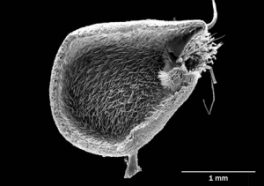
That's because the bladderwort is one of the fastest bug-eating plants on the planet. Low the water, the plant life's stems hold lilliputian bags, or bladders, that look like tilted teardrops. When an unsuspecting bug gets too close, the bag opens and — whoosh! — pulls the bug inside.

Exploitation high-velocity cameras, French and German scientists recently recorded videos of these plants in action, providing a nigher look at how bladderworts trap their prey. Each bladder has an scuttle at one end, sealed with a tiny covering and with sensitive hairs near the opening. When a bug swims draw near this mouth and brushes a hairsbreadth, the door flies unsettled. Water rushes in, delivery in the bug.
The whole process happens in fewer than a millisecond, which makes bladderworts some of the quickest plants connected Earth, say the scientists. There are 1,000 milliseconds in incomparable second. A millisecond passes quickly. In one millisecond, a car leaving 60 miles per hour travels barely one in. There are more than 300 milliseconds in the metre it takes to nictate an eye.
Scientists, including the illustrious naturalist Charles Charles Darwin, take up marveled at the bladderwort's traps for more than 100 years. However, the action is too fast to see with the human eyeball, and researchers weren't sure how the traps worked. Superfast cameras have straightaway revealed what the human eye OR even tralatitious cameras could not see.
Before a tease comes along, the plant pumps out all the water that came in with its last repast. The walls lightly kink inward, devising the bag resemble a deflated billow. The door at the end of the vesica is elastic and has small hairs that stick out into the water. The seal is tight, and neither air nor water can fetch in or out. The trap is ready.
Bladderworts eat small bugs, such as eyed Cyclops, tiny crustaceans that live in the water. (Crustaceans take over segmented bodies and tricky shells; larger crustaceans include shrimp and lobsters.) When one of these delicious bugs triggers a bladderwort's hairsbreadth, everything changes instantl, including the shape of the bladder. The door bursts open and the trap's walls relax. Water rushes in and fills the trap so fast that the bug doesn't have time to escape before the door shuts again.
"This kind of change of shape is very precipitous," Philippe Marmottant told Science News. Marmottant is a physicist at Joseph Fourier University in Grenoble, France, and worked happening the study.
In 2005, physicists foreseen how the entrap works. The new study and its bladderwort movies give them a chance to see the trap in natural action, and to see that the prediction was correct, Victor Albert told Science Newsworthiness. Albert, a biologist at the University at Buffalo in Spic-and-span York, did non process the study.
Succeeding time you construe a bladderwort's blooms ― which usually render up in spring OR summer, and tin can exist observed almost anywhere in the world — be thankful you're not a Cyclops liquid nearby.
POWER WORDS (adapted from the Yahoo! Kids Dictionary)
carnivorous plant A plant that can pin insects or other small organisms for food.
bladderwort A carnivorous plant that lives in the water or wet soil. Bladderworts have small, urn-shaped bladders that trap insects and crustaceans.
crustacean An animal that usually lives in the piddle and has a segmented body and delicate exoskeleton. Crustaceans admit lobsters, crabs, shrimps and barnacles, Eastern Samoa well as many smaller species.
millisecond Uncomparable-thousandth of a second.
0 Response to "Carnivorous plants say ‘cheese’"
Post a Comment